

Most homeowners start their exterior design journey on Pinterest. You find a photo of a Hamptons facade or a Mid-Century Modern roofline, and you fall in love.
Then reality hits.
You discover your block has a 15% slope. Or the “simple” extension you wanted triggers a requirement to upgrade your entire home’s bushfire protection. Or worse, you hire an architect who designs a stunning concept, only to find out later that the engineering required to build it costs 50% more than your budget.
We call this the “Architect Gap.” It happens when design disconnects from budget and site feasibility. It is the number one reason custom home projects stall.
At Adlington Homes, we believe a great custom home exterior design must pass three tests before we lay a single brick:
- Feasibility: Does it fit the legal (Council) and physical (Slope) constraints of your site?
- Durability: Will the materials survive the Illawarra’s salt air for 50 years?
- Value: Does the cost of the structure align with the value it adds to your property?
This guide explains how to navigate these decisions. It will help you decide if your vision fits your land and your wallet before you spend thousands on drawings.
This is a deep dive into exterior feasibility. For a full roadmap of the building process, read our Ultimate Guide to Building Your Dream Custom Home in Illawarra.
The Multi-Million Dollar Question: Is it Cheaper to Renovate or Rebuild?
We get asked this question more than any other.
On a flat block, a renovation is often 30% cheaper than a new build. However, if you are considering a sloping block home design in the Illawarra, a Knock-Down Rebuild (KDR) often provides better value per square metre than trying to stitch a new structure onto an old, shifting foundation.
Renovating on a slope fights gravity. If your existing home sits on an old pier-and-beam foundation, adding a second storey or a heavy rear extension requires massive structural reinforcement. We often see clients surprised that the steel propping required to hold up an old house during a renovation costs nearly as much as framing a new one.
The 75% Rule
We use a simple financial metric to help clients decide. If the estimated cost of your major renovation exceeds 75% of the cost of a comparable new build, the new build is almost always the smarter investment.
With a new build, you get a new statutory warranty, higher energy efficiency ratings (BASIX), and zero compromises on layout. With a renovation, you are often fixing past mistakes.
For a detailed breakdown of costs in our region, read our guide on Custom Home Costs in Wollongong.
The Hidden Costs of “Saving” the Old Structure
Many clients assume that keeping the existing walls saves money. Often, it does the opposite.
Structural Propping
To remove a load-bearing wall or add a second storey, we must support the existing roof and upper structure with temporary steel props. This is labour-intensive, dangerous, and expensive. In a rebuild, we start with a clean slate, which is faster and safer.
Foundation Risks
Putting a second storey on a 40-year-old home is risky. The original footings were likely designed for a single-storey load. To add weight, we often have to underpin the existing foundation. This involves excavating beneath your house and pouring concrete blindly. It is unpredictable and costly.
The Compromise Cost
Older Illawarra homes often have 2.4-metre ceilings. You cannot easily raise them without tearing the roof off. A custom new build allows for 2.7-metre or 3-metre ceilings, which increases the sense of luxury, light, and eventual resale value.
The “Skeleton Test”: Assessing Your Existing Home
Before you decide between a knock-down rebuild vs renovation, we must assess the “bones” of your current house. If your home fails these tests, a renovation is likely unviable.
- Brick Health: Are the bricks fretting (crumbling)? If moisture has wicked into the clay, rendering over it will not fix the problem. It will trap the moisture and cause the render to bubble within two years.
- Slab Integrity: Is the slab stable? If there are large cracks or signs of heaving, the cost to rectify the slab often exceeds the cost of pouring a new one.
- Termite Damage: Illawarra timber frames from the 1970s and 80s often have untreated termite damage hidden behind the plaster. We cannot build onto compromised timber.
WANT AN INSTANT ONLINE ESTIMATE?
How Illawarra Site Constraints Dictate Your Design (Not Just Your Architect)
Your land dictates your design. In the Illawarra, we deal with specific challenges: the escarpment shadow, steep gradients, and strict Wollongong Council zoning setbacks.
Navigating Slope and Topography
If your block has a gradient greater than 15%, standard project home designs will not work. You need a custom-engineered solution.
We generally use two methods to handle the ground:
- Cut-and-Fill: We carve into the hill to create a flat pad. This requires expensive retaining walls and drainage systems, but it gives you a flat backyard. This is ideal if you want a seamless indoor-outdoor flow to a pool.
- Split Level: We step the house down the hill. This reduces excavation costs and often results in a more interesting architectural design. However, it creates internal stairs, which may not suit “forever homes” designed for aging in place.
The Drainage Reality:
Water runs downhill. If you build at the bottom of the escarpment, you must manage overland flow. You may be restricted from building a basement or certain slab types without massive waterproofing costs.
Solar Orientation vs. Street Appeal
Many clients want big windows facing the street. But if your street faces west, those windows will turn your home into an oven in summer.
A smart custom home exterior design prioritises solar orientation. We position living areas to the north to capture winter sun and block harsh summer heat. This might mean your “best” windows face the backyard or a side courtyard, not the street. This is critical to meeting BASIX energy targets without incurring high costs for high-performance glazing.
The “Building Envelope”: Zoning, Setbacks, and Shadows
The Council rules define a “building envelope”—an invisible box you must build within.
- Front Setback: You generally cannot build closer to the road than your neighbours.
- Side Setbacks: On a standard lot, you need 900mm from the boundary. If you build a second and third storey, that setback often increases to prevent you from overshadowing neighbours.
The Townhouse Trap
We recently reviewed a project where a client wanted to build three townhouses on a standard block. While the width looked sufficient on paper, the drainage requirements and driveway gradients made it physically impossible to fit three units without violating setback rules.
This is why we stress feasibility. It protects you from spending money on designs that Council will never approve.
Checklist: Does your block support your design dream?
Before you pay for a concept design, check these four factors:
- Slope Gradient: Is the slope greater than 15%? If yes, expect higher site costs for engineering and earthworks.
- Frontage Width: Is your block wide enough for the double garage and grand entry you want? Narrow blocks often force the garage to dominate the facade.
- Easements: Check your Section 10.7 certificate. Is there a stormwater pipe running through your backyard? You cannot build over it.
- BAL Rating: Are you in a Bushfire zone (Illawarra Escarpment)? If your BAL rating is high (e.g., BAL-40 or Flame Zone), you cannot use standard timber decking or cladding. You must use non-combustible materials like steel, concrete, or specific hardwoods. You can check your zone via the NSW Rural Fire Service.
The "Seamless" Extension: Preventing the "Bolt-On" Look
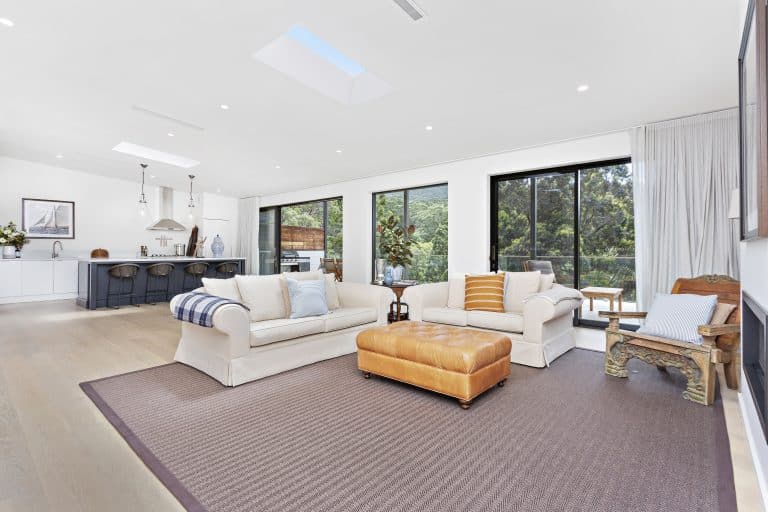
A common fear with a home extension integration is that the new work will look “bolted on.” You want the house to look like a single, unified property, not a Frankenstein of different decades.
We use specific design strategies to solve this.
The Roofline Challenge
The hardest part of an extension is the roof. Pitching a new roof into an old one often creates complex “box gutters” where the two roofs meet. These are prone to blocking and leaking during heavy Illawarra storms.
Sometimes, the best design isn’t to match the roof, but to separate it. We might use a glass linkway or a distinct skillion roof to simplify the connection and reduce leak risk.
Strategy A: Match and Render
If your existing bricks are no longer in production (common for 1980s homes), you cannot match them. The solution is to render the entire house—old and new—to create a uniform finish.
Warning: If you do this, you must replace the old gutters, fascias, and downpipes to match the new colour scheme. Nothing ruins a renovation faster than fresh render paired with rusted, 30-year-old gutters.
Strategy B: Intentional Contrast
Sometimes, trying to match looks worse. It looks like a “near miss.”
A better approach is intentional contrast. We keep the original brickwork on the main house and use a modern, lightweight cladding like James Hardie Linea Board on the extension. This defines the new section as a distinct architectural feature. It looks deliberate, modern, and respects the history of the original home.
Coastal Durability: Designing for the Salt Air
If you build within 1km of the ocean, salt spray will attack your home 24/7. Materials that last decades in Western Sydney can fail within five years here.
At Adlington Homes, we mandate marine-grade fixings for coastal projects. Standard galvanised nails and screws rust and expand, causing cracks in your render and cladding. Stainless steel is an investment in longevity.
To learn more about selecting durable products, read our guide on Choosing the Right Building Materials.
The “1km Zone” Reality
“Aerosol salt” is invisible, but it is destructive. It doesn’t just rust metal; it eats into porous render and timber. If you live in this zone, your exterior design is not just about aesthetics; it is about armour.
Exterior Material Selection Guide
Material | Aesthetic | Coastal Durability | Maintenance Frequency | Relative Cost |
Face Brick | Traditional / Industrial | Excellent | None | High |
Acrylic Render | Modern / Clean | Good (if washed) | Repaint 7-10 years | Medium |
Fibre Cement (Linea) | Hamptons / Coastal | Excellent | Paint 10-15 years | Medium |
Natural Timber | Warm / Organic | Poor | Oil/Stain 6-12 months | Medium/High |
Colorbond Ultra | Modern / Sleek | Excellent | Wash down yearly | Low/Medium |
The Truth About Timber in the Illawarra
We love the look of natural timber, but in the Illawarra, it breaks hearts. The sun bleaches it grey, and the salt dries it out.
If you insist on natural cedar cladding, you must be prepared to oil it every 6 to 12 months. If you miss a cycle, it will fade unevenly and cup.
The Solution:
We recommend using timber-look aluminium (like DecoWood) or composite battens for high-up areas you cannot easily reach with a ladder. You get the warmth of wood without the weekend maintenance.
The Hidden Costs of Exterior Complexity
A custom home costs more than a project home because it is complex. However, some design choices add cost without adding proportionate value.
Roof Complexity and Waterproofing
A simple hip or gable roof is cost-effective and sheds water efficiently.
When you add parapets (walls that conceal the roof to create a flat-box look) and internal box gutters, you increase costs by 15-20%. These features require expensive waterproofing membranes and custom flashing. They also require more frequent maintenance to prevent blockages.
Window Systems and Glazing
The size of your windows dictates the structure of your walls. Standard residential window frames have size limits. If you want a 4-metre-high glass wall, you move into “Commercial Grade” framing. The price difference is significant.
Furthermore, double glazing is no longer a luxury; it is essential to meet BASIX energy ratings and to reduce road noise.
“Concept Pricing”: Bridging the Architect Gap
This brings us back to the “Architect Gap.”
To avoid designing a home you cannot afford, we offer Concept Pricing. We price your exterior concept early—before you pay for final engineering drawings.
This allows you to make trade-offs while the design is still on paper. You might decide to replace expensive natural stone cladding with a synthetic alternative, or replace a copper roof with Colorbond. These decisions can save tens of thousands of dollars and ensure your project actually gets built.
Learn more about our approach to Custom Home Services.
Case Study: The "Stay and Extend" Strategy
(Based on a common Illawarra sloping block scenario)
We often encounter owners of 1980s brick homes on steep blocks in suburbs like Balgownie or Figtree who feel stuck. They want a modern look, but face massive site costs for a rebuild due to driveway gradients.
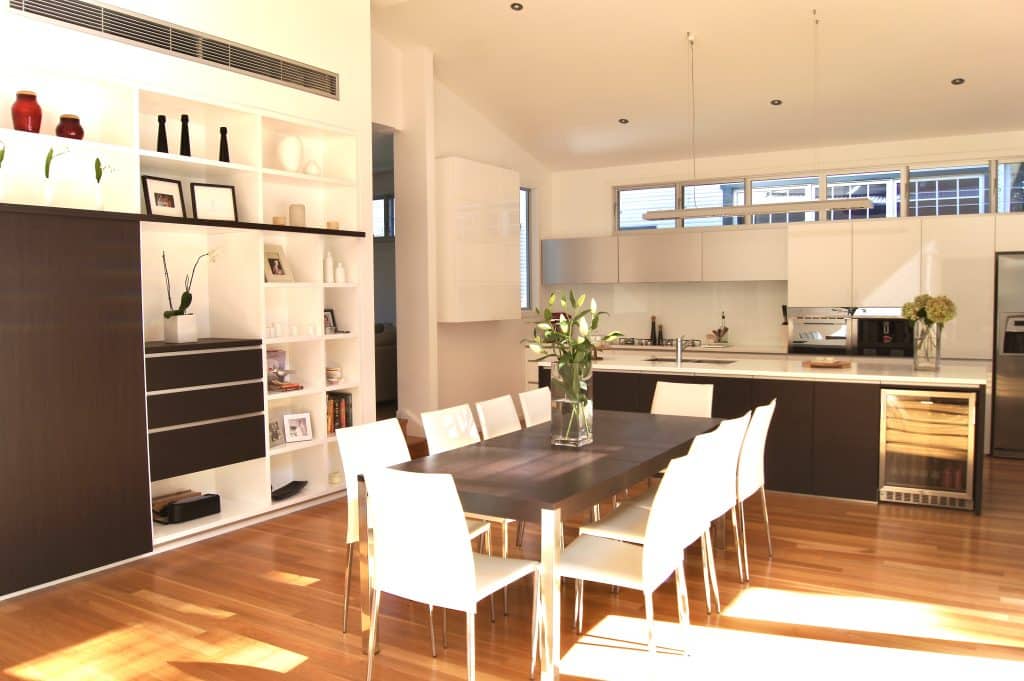
In a recent consultation, we assessed a client’s solid brick home. Instead of demolition, we validated that the existing slab was stable. We stripped the roof, framed a lightweight second storey using low-maintenance exterior cladding (Scyon Axon), and rendered the ground floor brickwork to match.
The Result:
- They achieved a modern “Box Modern” aesthetic.
- They avoided approximately $80,000 in groundworks and excavation costs required for a new build.
- They retained their established gardens and landscaping.
This approach works only because we validate the structure first. Feasibility saves the project.
FAQ: Common Questions on Illawarra Exterior Design
Yes, but only if the brick ties and mortar are sound. We perform a “scratch test” and structural inspection first. If the brick is fretting or the mortar is turning to dust, rendering will trap moisture and cause the wall to fail. In those cases, we must strip and re-clad or repair the brickwork first.
BAL stands for Bushfire Attack Level. If you are in a BAL-40 or Flame Zone (common near the Escarpment), you cannot use standard timber. You must use non-combustible materials, which limits your design choices and increases cost.
For a compliant design (Complying Development Certificate), approval can take 4-6 weeks. For a Development Application (DA) with variations (e.g., height or setbacks), it typically takes 3-6 months in the Illawarra. Read more about timelines in our Custom Home Building Timeline Guide.
Generally, yes. It modernises the curb appeal instantly. However, a poor render job over bad bricks is a liability, not an asset. Buyers (and building inspectors) will spot bubbling render immediately.
Feasibility First, Aesthetics Second
A beautiful exterior is useless if it leaks, rots, or bankrupts the budget. The best homes in the Illawarra are designed with the site—and the salt—in mind.
If you are unsure if your block can handle the design you have in mind, do not guess. Get a clear picture of your constraints and costs early.
Book a Site Feasibility Assessment with Adlington Homes. We will review the slope, sewer lines, and zoning before you invest in design.